| |
|
|
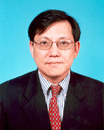
M.Phil. Cantab,
Ph.D. LSE
Dean,
Faculty of Social Sciences
The
University of Hong Kong
The Changing East Asian Regional Order in the Post 9.11 World:
Implications for Hong Kong
Abstract:
The world has been transformed
since the terrorist attack against the United States on September
11, 2002. Although East Asia has not been the focus of attention in
the American-led global campaign against terror, the terrorist
attacks altered both US perceptions of the security role of the
region and East Asian calculations of regional security concerns,
including issues like the North Korean nuclear programme and the
future of Taiwan.
As East Asia emerged out of the
Asian Financial Crisis, strengthened by the recognition that not
only had it survived difficult economic challenges, but also that
the prospects for closer regional cooperation became much more
promising by the beginning of the new millennium, it is confronted
with the dual challenge of dealing with the post-September 11 world
order and a rising China.
In the context of wider global
transformation, the emerging regional order in East Asia is bringing
major challenges to Hong Kong as the Special Administrative Region
pursues continuing success as a world city under the one country two
systems framework. |
| |
|

Prof Victoria Hardy
CFM, CFMJ
Past
Chair
International Facilities Management Association Foundation
The Future for Facility Management: Reading the Bones…
Abstract:
The future of facility management
is a mirror image of the shifting paradigms in the global business
community. We already see some of the shifts and changes: the
maturation of the profession; the recognition of the value of good
FM, the consequences of poor practices, and the importance of
certification and education.
We live and work in the 21st
Century; but some of our practices and the people we work for are
still rooted in the 19th Century. We must begin to think not only
“out of the box,” but maybe there will no longer BE boxes.
William Cobb, the Senior
Vice-President of eBay’s international operations, an online
community of more than 30 million buyers and sellers, tells us:
“Some of the terms you learn in business school –drive, force,
commit- don’t apply. We are over here listening, adapting,
enabling”. Those words could certainly describe the profession of
Facility Management today as well. Will they be the same terms for
tomorrow’s Facility Executive? |
| |
|
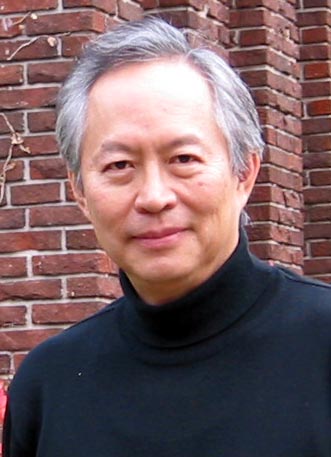
Mr Alex
K Lam
MTS, MRAIC, Cert. EQ-I Admin.
VP -
Global Learning Asia CoreNet Global
Corporate Real Estate - Vision 2010
Abstract:
In the early 1990s, Corporate Real Estate 2000
created a powerful new vision for the corporate real estate
industry. Since then, the business environment has changed a lot.
Globalization is no longer a concept, but a reality. Outsourcing is
no longer a fad, but an important strategic business practice. The
web is no longer a toy, but a business tool to support global
enterprises. Now at the beginning of the 21st Century, the subtle,
but steady, advance towards the networked world is one of the most
significant long-term trends in business. It has profound impacts on
corporate real estate (CRE) and facilities, the service provider
industry, and CRE professionals. Now an exciting new vision is
emerging. Vision 2010 is a major study conducted by CoreNet Global,
the world's premier association for corporate real estate and
related professionals, to examine the role corporate real estate and
facilities play in enabling work in the networked world. In this
session we will present the findings of this important research and
explain why this is important to Hong Kong and China. |
| |
|
Dr
Danny S S Then
PhD, MSc, BSc(Hons),
F.PFM, MBIFM, MCIOB, MCMI
Programme
Leader, Graduate Programme in Facility Management
The Hong Kong Polytechnic University The
Future of Professional Facility Management Education in the Asia-Pacific Region
Abstract:
This paper on the future of professional facility
management education in the Asia-Pacific region is an attempt to
provide an overview of FM educational development over the past 25
years, and then speculate on its likely development in the
Asia-Pacific region. The context of the paper will inevitably be
conceptual in that any attempt to define the scope and the potential
role of an evolving discipline like “facility management” is bound
to raise controversy. |
| |
|
Mr K T
Lee
MIEE, MHKIE, RPE
General
Manager Beijing Jingwei Property Management Co Ltd
(a wholly owned
subsidiary of PCCW Ltd) Success
Measure of Various Services
Abstract:
This paper aims to share the experience of the author
in measuring result of various services rendered by a Service
Provider in a Facilities Management Contract. Establishment of
success measure starts with understanding of the client’s need and
setting up of performance indicators. After that, it is necessary to
develop methodology to work out the result. During service levels
are delivered and customer is satisfied. Data shall be captured and
analyzed during and after service delivery. Finally, the result of
the services shall be reported to the client in a systematic manner. |
| |
|
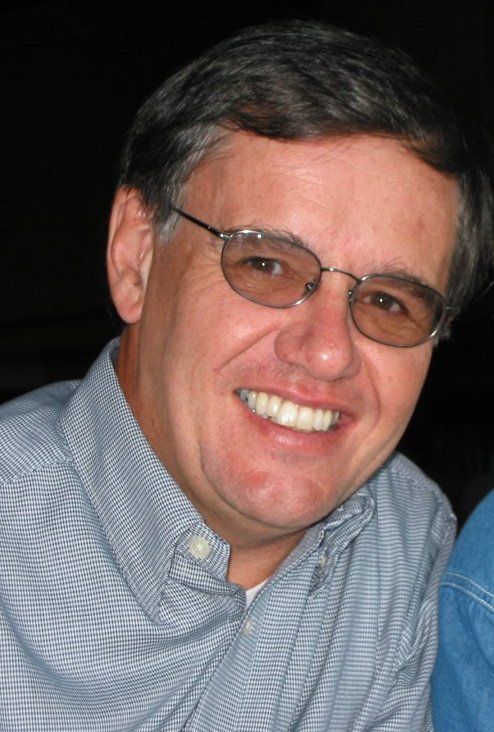
Mr Mike
Hudson
MSc, FHKIE, FCIOB, CFM
Director
of Estates Management Office
The Hong Kong University of Science and Technology
Facility Management for Universities
Abstract:
This paper discusses why universities provide an
ideal environment for comprehensive facility management, and how the
principles, processes, and skills are applicable to professionals
managing other types of facility. It examines the complex customer
groups, the diverse range of processes, and the resulting multitude
of facilities to be found in universities. Increasing pressures from
rising customer expectations, a more demanding and litigious
society, ever more sophisticated technology, and severe financial
constraints are some of the factors that have influenced the current
environment within which university facility management
organizations operate. Whilst the focus is on customer service and
performance measurement, we are reminded that it is essential not to
lose sight of the basics of facility management and the
comprehensive range of skills that must be acquired by facility
management professionals. Emphasis is placed not only on competency
and adding value, but on proving the worth of a professional
facility management organization to a university. The paper
concludes that this in turn is likely to produce enhanced resources
that will be available to further improve stakeholder satisfaction
and preserve an institution’s most valuable tangible assets.
|
| |
|

Ms Mary
Wan
MHA, MSc(FM)
General
Manager (Administrative Services)
The Pamela Youde Nethersole
Eastern Hospital
|
| |
|
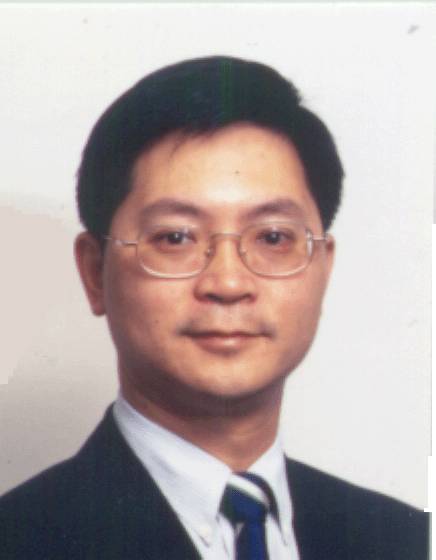
Ir
Alfred Sit
MBA, MIEE, MHKIE, F.PFM, CEng
Chief
Engineer Electrical & Mechanical Services Department, Hong Kong SAR
Government
Risk Management in Hospital Facility Management ─ A Case Study in
Hong Kong
Abstract:
This paper is about how Pamela Youde Nethersole
Eastern Hospital of Hong Kong, with the support of the Electrical &
Mechanical Services Department, develops risk management strategy in
the facility management services of the hospital. The hospital, an
acute regional hospital serving Hong Kong is Eastern region, is well
known for pioneering new systems and good practices for its
developments in facility management over the last decade. The paper
will also demonstrate how risk management can help improve service
quality and enhance the cost-effectiveness of facility management in
a large public organization. |
|


 HK Conference on New World Order in FM - Speakers